Surfer's Myelopathy:Paralysis Without a Wipeout
A non-traumatic spinal cord infarct from sustained prone paddling, not from impact. The prodrome that reads as a pulled muscle, why a lumbar bend produces a thoracic lesion, and why the urgency is diagnostic rather than therapeutic.
A beginner walks out of the water after his first lesson and cannot move his legs an hour later. There was no wipeout, no reef, no board to the head. He paddled, and that was enough.
When Alva-Díaz and colleagues pooled 104 cases from 42 articles for their 2022 synthesis in Journal of Neurology, surfing accounted for 60 of them, 58%. The rest were yoga, general exercise, and a scatter of other hyperextension activities, with about a fifth of the cases never recording what the person had been doing at all. Every case involved a non-traumatic hyperextension event, and the authors concluded that the syndrome is better understood as an acute hyperextension-induced myelopathy that happens to have been described first in novice surfers. Their paper argues the point in its title.
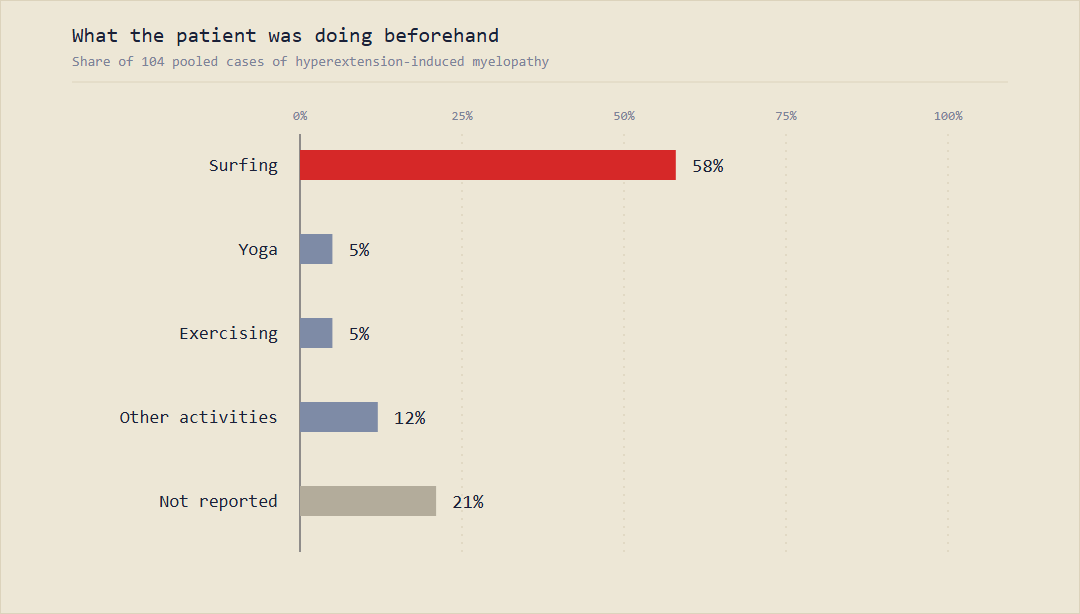
That matters at the bedside more than it matters in the literature. A clinician holding "surfer's myelopathy" as the entity name is running a search filter with the wrong key. The gymnast, the yoga student, and the swimmer who present with hyperacute back pain and ascending leg weakness fit the same mechanism and the same imaging signature, and they do not trip the eponym. The syndrome was described in surfers in 2004 by Thompson and colleagues because Hawaii has a large population of first-time surfers holding one posture for hours. The posture is the cause. The surfboard is incidental.
The mechanism, and what is actually settled about it
Prolonged prone paddling holds the lumbar spine in sustained hyperextension. On a soft-top, with the chest lifted and the chin up to watch the horizon, a beginner can hold that arch nearly continuously for the length of a first lesson. The experienced surfer breaks the posture constantly, sitting up between sets, duck diving, standing. The beginner rarely sits up at all.
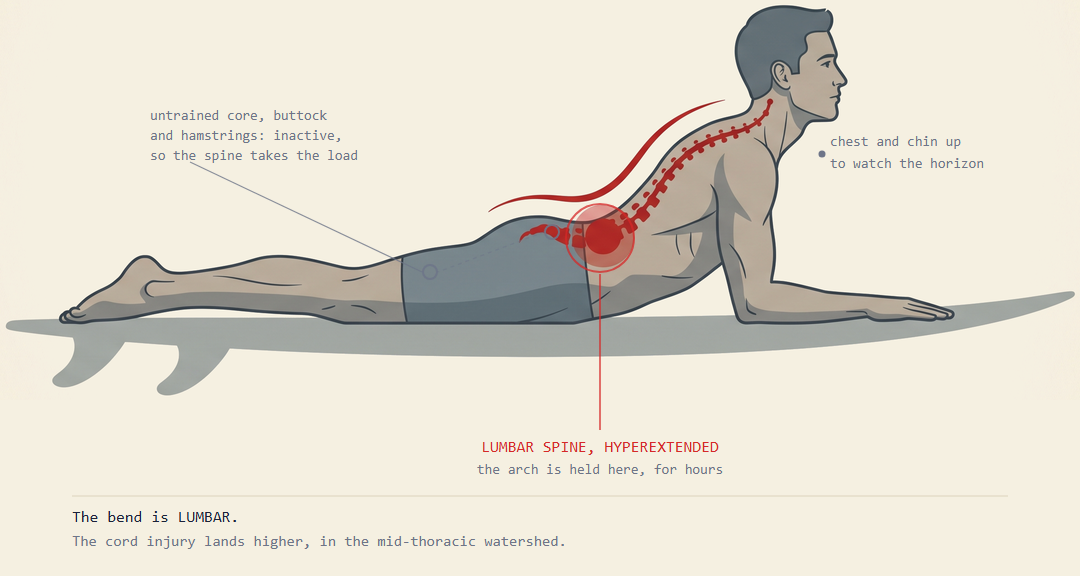
What that posture does to the cord's blood supply is where honesty is required. Nakamoto and colleagues, reporting the largest single-institution radiologic series, state plainly that the etiology is unknown. Four mechanisms have been proposed: arterial insufficiency from lumbar hyperextension, venous hypertension from compression of the inferior vena cava by the liver in the prone position, fibrocartilaginous embolism from retrograde embolism of nucleus pulposus material into radicular arteries, and avulsion of perforating vessels.
The imaging favors the arterial account, and it also exposes the most counterintuitive fact about this condition. The bend is lumbar. The injury is thoracic. The surfer arches his lower back, and the cord dies several segments above it. Every patient in the Hawaii series showed signal change extending from the mid-thoracic cord down to the conus, with the upper edge sitting between T5 and T10, well clear of the lumbar segments doing the bending.
The explanation is vascular, not mechanical. The lesion sits in the territory of the artery of Adamkiewicz, the great anterior radiculomedullary artery, which arises low, between T9 and T12 in roughly 75% of people, T5 to T8 in 15%, and L1 to L2 in the remaining 10%. That single vessel supplies the entire lower cord. Unlike cerebral vessels, the spinal arteries run along a mobile structure, which makes them vulnerable to mechanical insult during sustained hyperextension. Compromise the supply down at the bend and the tissue that starves is upstream, in the mid-thoracic watershed where collateral supply is thinnest. The variable upper level of injury across patients tracks the variable origin of the artery itself.
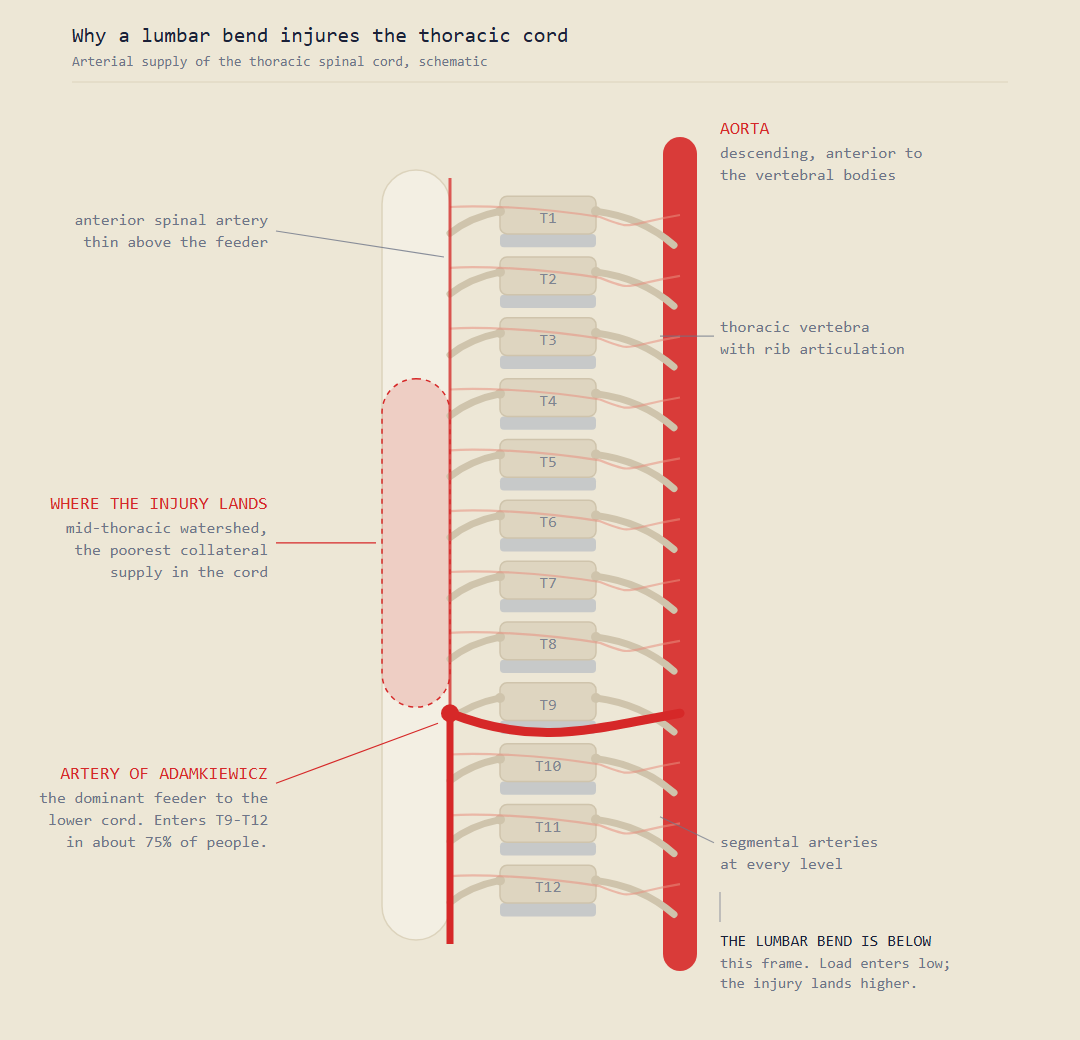
So the field-facing statement is that this is a spinal cord infarct produced by posture. The precise vascular pathway, whether dynamic compression, vasospasm, or thrombotic infarction, remains a reasoned inference from imaging rather than a demonstrated fact. The literature hedges here, and the hedge is worth preserving. It does not change what anyone does in the water.
The prodrome is the whole warning
Every one of the 104 pooled cases presented with pain of hyperacute onset. That pain is the only advance notice the body gives, and it arrives disguised as the most ordinary complaint in surfing.
A beginner comes in from a long first session with mid or lower back pain. On its own that is unremarkable, because paddling with an untrained posterior chain produces sore backs constantly and every surf instructor has heard the complaint a thousand times. The sequence that follows is what separates the two: leg weakness, paresthesia, or numbness, progressing to paraparesis or frank paraplegia over minutes to hours.
The windows are tighter than most people expect. The education material circulated through Hawaii's Neurotrauma Program puts first symptoms, low back pain or leg weakness, at roughly 30 to 90 minutes into a first session, and inability to walk anywhere from 30 minutes to 4 hours after that. This is not a condition that declares itself the next morning. It runs its course inside the lesson and the drive home.
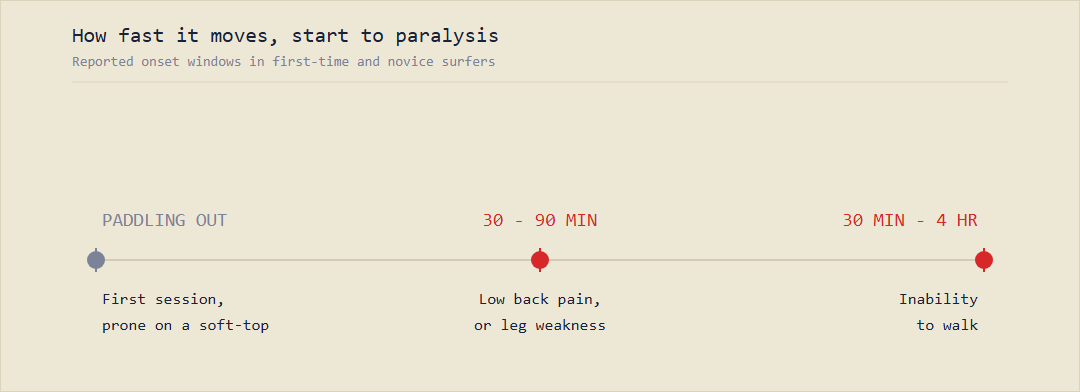
The discriminator is not the back pain. It is any lower-extremity sign accompanying it.
Bladder or bowel dysfunction was the most frequent clinical feature in the pooled series, present in 84%. In the Hawaii radiologic series, 22 of 23 patients had urinary retention on post-void residual at admission. Urinary retention in a young healthy person after a first surf session is not a subtle finding, but it is easily not asked about, and a patient who is embarrassed and expects to be told they pulled something will frequently not volunteer it.
The recognition rule for the beach is narrow enough to hold in the head. A novice off a long first session, with back pain plus any leg symptom or any bladder symptom, is not having a muscle problem until a facility has proven otherwise. The failure mode is the patient sent home to rest a sore back who progresses to a permanent deficit over the following hours.
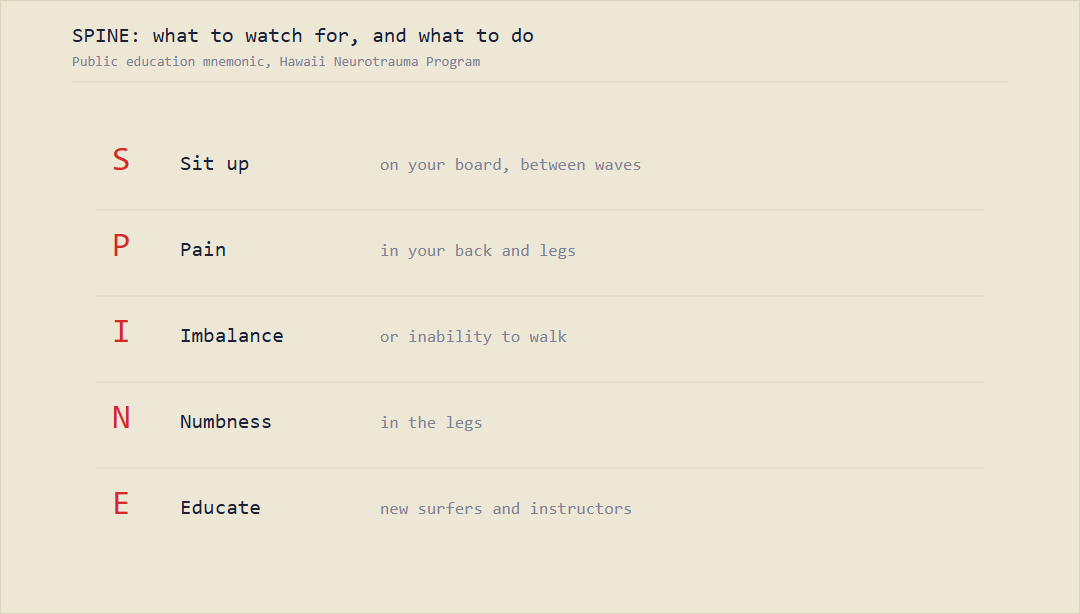
Hawaii's Neurotrauma Program teaches the pattern as SPINE, which is worth knowing because it is the version a surf school or a lifeguard is most likely to have already seen: sit up on your board, pain in your back and legs, imbalance or inability to walk, numbness in the legs, educate new surfers. It packages prevention and recognition in the same five letters, which is the right shape for the audience it is aimed at.
The field response is short, and it is honest about its own limits
There is no field intervention that reverses the ischemic injury. Nothing in a kit changes the outcome.
What the field does is recognize the pattern, stop the activity, keep the patient supine, and move them toward a facility with thoracolumbar MRI and neurology access. Not an outpatient scan the next morning. New-onset paraparesis in any patient is a neurologic emergency until aortic dissection, epidural hematoma, transverse myelitis, and a compressive lesion have been excluded, and several of those mimics carry their own short clocks.
This is the part worth being direct about with a colleague: the urgency here is diagnostic, not therapeutic. The evacuation is not carrying a reversal. It is buying a diagnosis, excluding the mimics that do have time-critical management, and establishing a baseline neurologic exam that recovery can later be measured against.
What the outcome data support, and where it thins out
The imaging signature is consistent. All 23 patients in the Hawaii series showed pencil-like, centrally located T2 hyperintensity extending from the mid-thoracic cord to the conus, with cord expansion, on MRI performed within 24 hours of symptom onset. T1 signal was normal in every case. The lesion spanned 3 to 7.5 vertebral levels, mean length 13.8 cm.
The prognostic finding is the useful one, and it is also where the evidence gets thin. ASIA score at admission correlated strongly with clinical improvement. Every patient presenting at ASIA A or B, 7 of 20 with follow-up data, showed no improvement. Roughly 65% overall showed no ASIA improvement from admission. MRI characteristics predicted nothing: not severity, not recovery.
Two caveats belong with those numbers. Median follow-up in that series was 6 days, interquartile range 3 to 14 days, because most patients were visitors to Hawaii who transferred home. A 6-day outcome in spinal cord injury is an early snapshot, not a final one. The pooled synthesis, working from discharge and follow-up data across the literature, found 52% partially recovered, which is a materially less bleak picture than a 6-day window suggests.
A second decomposition is worth putting alongside it. The education deck circulated through Hawaii's Neurotrauma Program, drawing on Choi 2018 together with the pooled synthesis, splits recovery at discharge four ways: no improvement 26%, partial improvement 38%, total recovery 14%, not reported 22%.
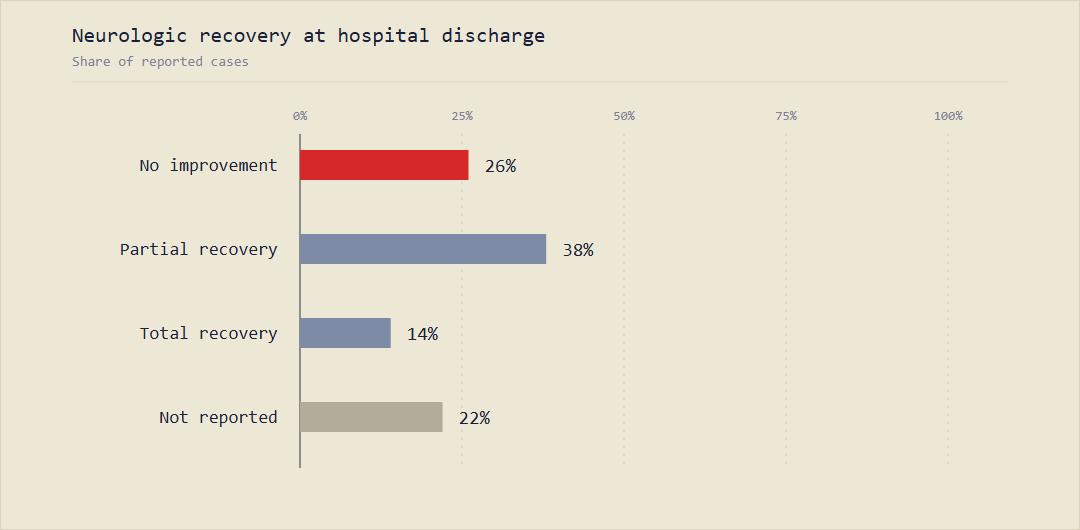
Those two figures do not reconcile cleanly, and the gap is instructive rather than embarrassing. The synthesis reports 52% partially recovered; the deck's breakdown puts partial improvement at 38%. Different pooling, different denominators, and a fifth of the deck's cases have no reported outcome at all. Both are honest summaries of a literature made almost entirely of case reports, which is what a body of evidence looks like before anyone has run a registry. The number to carry is not either percentage. It is that a substantial minority never improve, and that where a patient lands is set mostly by how severe the deficit already is when the diagnosis is made.
The same synthesis records what those 104 patients actually received. Steroids in 48%, physical therapy in 25%, antiaggregants or anticoagulants in 5%, something else in 10%, and nothing recorded at all in 43%. Read that as a description of uncertainty rather than a menu. When the most common intervention appears in fewer than half the cases and the second most common is rehabilitation, the field has no settled answer.
Choi and colleagues' 2018 series is small enough to be read as illustration rather than evidence, and it illustrates the point sharply. Three novice surfers, aged 19 to 30, admitted not to Hawaii but to a hospital in Korea, which is its own quiet argument against treating this as a Hawaii problem. Two received high-dose steroids and remained completely paraplegic, still requiring catheterization after months of rehabilitation. The third, managed with induced hypertension, recovered almost fully. Three patients cannot establish that induced hypertension works. What they do show is the spread of outcomes inside one small series from one hospital.
Seven patients in the Hawaii radiologic series received the full NASCIS intravenous methylprednisolone protocol. Steroid administration was not associated with improvement. With an n of 7 in a retrospective series, that result excludes very little, and it should be read as an absence of evidence rather than evidence of absence. No controlled trial exists for any intervention in this condition, and given the incidence, none is likely to.
The case that may or may not be the beginning of something
In 2023 a Hawaii group reported a 30-year-old man with complete paraplegia after his first surfing lesson. He underwent spinal angiography within 10 hours and spinal perfusion pressure optimization, by mean arterial pressure augmentation and CSF drainage, within 24 hours. The angiogram showed disconnection of the right T12 radicular artery from the anterior spinal artery, with the left T12 vessel feeding across the midline to supply the artery of Adamkiewicz. By day 14 his MRI had improved substantially. He was walking with assistance at 3 months and independently with forearm crutches at 6 months.
That is a genuinely striking result from ASIA-A presentation, and the authors argue it supports changing the standard of care toward emergent angiography and perfusion-based intervention.
It is also a conference abstract describing one patient. Recovery from complete motor loss is rare in this condition but not unheard of, and a single case cannot separate an effective intervention from a favorable natural history. What would settle it is a multicenter registry with protocolized early perfusion management and ASIA outcomes at 6 and 12 months. Until something like that exists, this is a hypothesis worth knowing about and not a protocol. Physicians working in high-incidence regions may reasonably want it on the table in the first hours; that is a different claim from established practice, and the distinction is worth keeping clean.
What this means for a surf school
Prevention here is mechanistic reasoning, not trial-backed protocol, and it should be presented that way. No controlled prevention study exists. What follows from the mechanism is that the posture should be interrupted.
Cap sustained prone paddling on a first session. Break it up deliberately: sit up on the board between waves, stand on the beach, change position often. Watch for the sustained chin-up posture that soft-top paddling encourages, because that is the deepest arch a beginner holds. The public education material circulated through Hawaii's Neurotrauma Program leads its prevention mnemonic with the same instruction, S for sit up on your board, followed by pain, imbalance, numbness, and educate new surfers.
And brief the instructors on the prodrome, because they are the ones who will hear about it first. A student who mentions back pain during a lesson is almost always just sore. The one who mentions back pain and a leg that feels heavy, clumsy, or numb is a different conversation, and it ends with an ambulance rather than with ice and a rest day.
The condition is rare. It is also concentrated almost entirely in one population, doing one thing, in one posture, on one particular day of their lives. That is an unusually tractable target for recognition, which is most of why it is worth teaching at all.