Lightning and the Lineup:Why Counting Seconds Fails
The 30/30 rule taught a generation to count, and the National Weather Service has quietly stopped teaching it. What replaced it, why the strike mechanism everyone pictures is the rarest one, and why lightning is the one mass-casualty scene where the pulseless are worked first.
You were taught to count. See the flash, count the seconds, and if you reach thirty before the thunder arrives, the storm is far enough away to finish the session. Most of us learned some version of it. It is printed on camp handouts and lifeguard placards and it has a tidy name, the 30/30 rule.
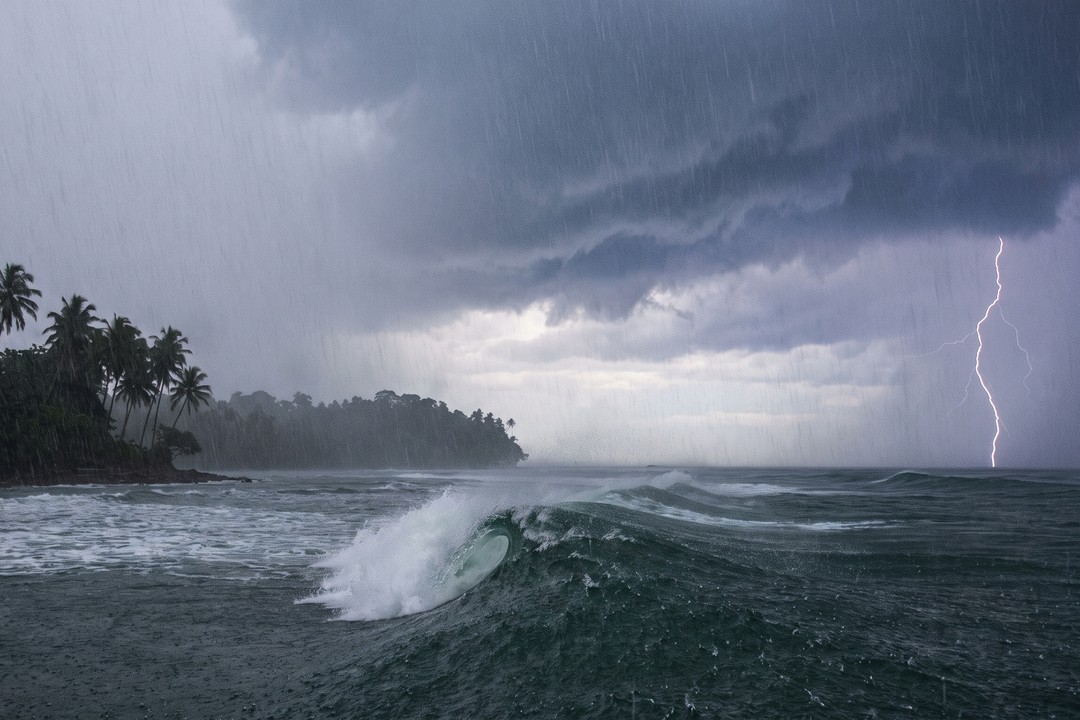
The National Weather Service has quietly stopped teaching the counting half of it.
Their current public safety pages do not mention it. What they teach instead fits in one line: if you can hear thunder, you are already within range of the next strike. The slogan they replaced it with, "When Thunder Roars, Go Indoors," has no arithmetic in it at all, and that is the point. Counting implies there is a number at which you are safe. There is not one. The second half of the old rule survives intact, and it is the half nobody follows: stay off the water for thirty minutes after the last thunder you hear, not thirty seconds after the storm looks like it has moved on.
The rule did not fail because the physics changed. It failed because of what people did with it. A threshold invites negotiation. Twenty-eight seconds becomes close enough, one more set becomes reasonable, and the number that was meant to end the discussion becomes the opening bid.
The distance you cannot see
The reason a clear sky overhead means very little is that lightning does not respect the boundary of the cloud that made it.
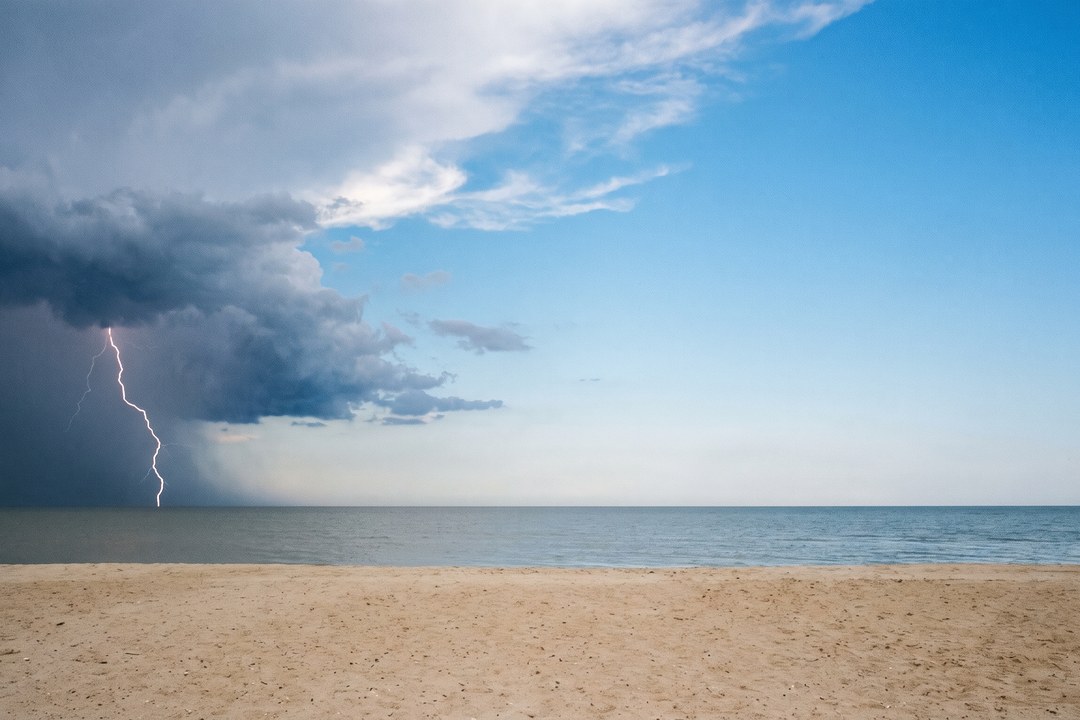
Strikes are documented reaching 6 to 9 miles, roughly 10 to 15 kilometers, from their parent storm, and the wider literature records considerably longer. That is the bolt from the blue: it exits the side or top of a thunderstorm, travels horizontally, and comes down under sky that looks entirely benign from below. From the water, a storm sitting on the horizon and a storm capable of reaching you can be the same storm. There is no visual cue that separates them.
Thunder is the only reliable instrument you have out there, and it is a blunt one. Sound carries roughly ten miles under good conditions, less against wind, less again over the noise of surf. So audible thunder means the storm is inside striking range. Inaudible thunder does not mean it is not.
The mechanism everyone pictures is the rarest one
Ask anyone to describe a lightning casualty and they will describe a direct strike: a person, a bolt, a straight line between them. Direct strikes account for about 5% of lightning injuries.
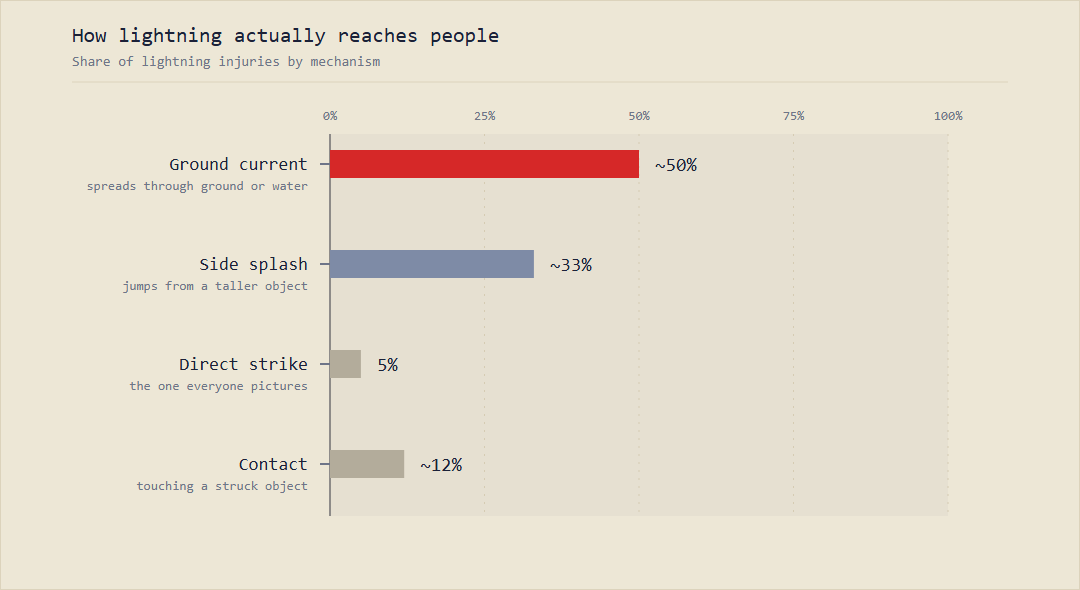
Ground current is the most common mechanism, accounting for roughly half of casualties. Lightning strikes the water, or a tree, or the sand, and the energy spreads outward through the conductive medium from the point of contact. Anyone standing in that medium becomes part of the circuit. The National Weather Service is explicit about why this one dominates: ground current affects a far larger area than any other mechanism, so it reaches more people per strike.
Side splash accounts for about a third. Current strikes a taller object, then jumps to a nearby person following the path of least resistance. Sheltering under the tallest thing around, which is the instinct, is the specific behavior this mechanism punishes.
Contact injury makes up most of the remainder, where the victim is touching an object that is struck. Indoors, a fifth route dominates: conduction through plumbing and wiring, which is why the advice about staying off corded phones and out of the shower during a storm is not folklore.
For a surfer this reorganizes the entire risk picture. Sitting in the lineup you are the tallest object on a flat conductive plane, which is the direct-strike concern and the one worth respecting. But the more likely injury does not require the bolt to find you at all. It requires only that it lands somewhere in the water you are sitting in.
What lightning does to a body
Lightning is not electrocution in the household sense, and it is not primarily a burn. Full-thickness burns occur in fewer than 5% of cases. The exposure is measured in thousandths of a second, carrying current on the order of 30,000 to 110,000 amperes. Most of it flashes over the outside of the body rather than traveling through it. What matters is the fraction that does travel through, and where.
The heart stops first. The dominant immediate cause of death is simultaneous cardiac and respiratory arrest. The rhythm is characteristically asystole, produced by every myocardial cell depolarizing at once, rather than the ventricular fibrillation of most other cardiac arrests.
Then something unusual happens.
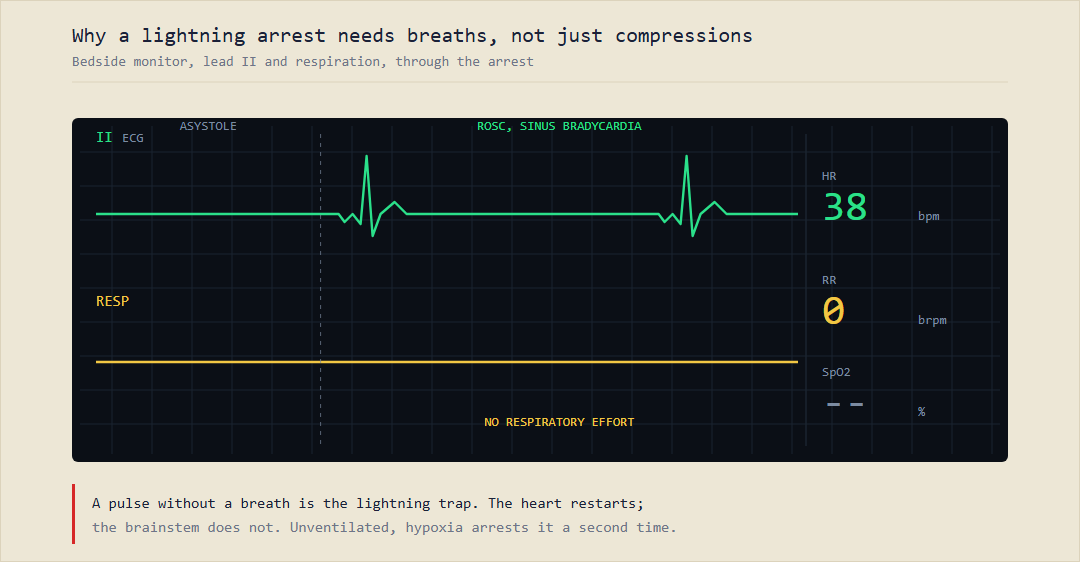
The heart often restarts by itself. Automaticity returns, usually as a sinus bradycardia, and circulation comes back without anyone doing anything. But the medullary respiratory center, the brainstem tissue that drives breathing, stays paralyzed for longer than the heart stays stopped.
So there is a window in which a person has a pulse and is not breathing. If nobody ventilates them, the resulting hypoxia stops the heart a second time, and that arrest is the one that kills them. StatPearls states it plainly: a second cardiac arrest from continued paralysis of the respiratory center occurs if treatment is not promptly initiated.
This is why lightning resuscitation emphasizes breathing to a degree that sits oddly against a decade of compression-only messaging for cardiac arrest. Compression-only CPR is excellent guidance for the collapsed adult whose problem is a fibrillating heart with oxygenated blood still in the system. It is the wrong tool for a lightning casualty, whose problem is a brainstem that has stopped driving the diaphragm.
The scene where the rules invert
Standard mass-casualty triage sorts for salvageability. The pulseless are categorized as expectant and passed over, because in blunt trauma or blast injury a person in arrest is rarely recoverable and the resources spent on them cost the people who are.
Lightning inverts this completely.
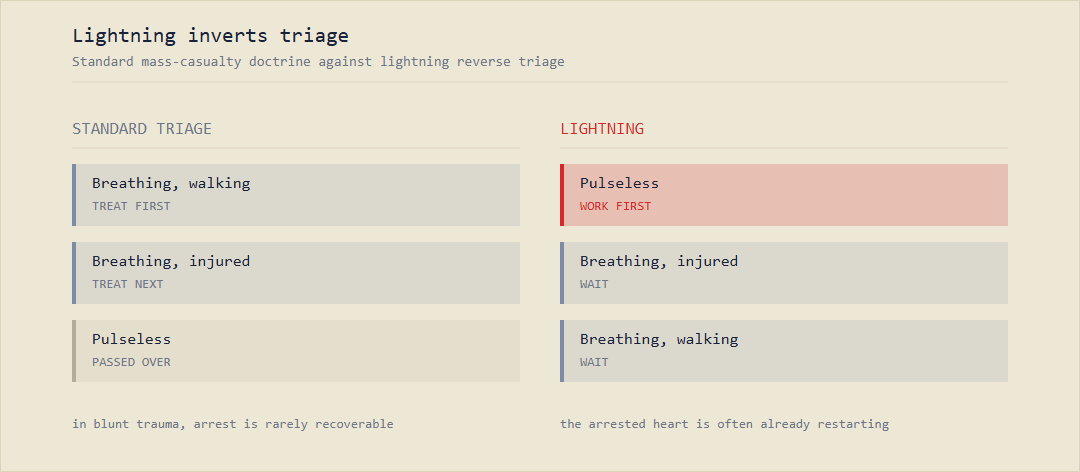
In a multiple-casualty lightning scene, the people in apparent cardiac arrest are resuscitated first. The reasoning follows directly from the mechanism above: their hearts may already be trying to restart, they need ventilation to survive the gap, and that ventilation is a cheap intervention with a genuine chance of working. Meanwhile those who survived the initial strike rarely die afterward, so they can wait. StatPearls calls failure to triage this way a source of avoidable mortality.
This is about allocation when several people are down at once, and it rests on the specific physiology of a heart that restarts and lungs that do not. Lightning arrest still carries a poor prognosis in general.
The findings that identify a strike
Several signs are close to unique to lightning, and recognizing them matters mostly because they tell a clinician what they are looking at when the history is unclear.
Lichtenberg figures are a transient ferning or feathering pattern that appears on the skin, branching like frost on glass. They are pathognomonic for lightning, meaning their presence effectively settles the question. They are not burns, the mechanism producing them is still not fully understood, and they fade on their own.
Keraunoparalysis is a temporary paralysis caused by vascular spasm and autonomic instability rather than by nerve destruction. The affected limbs, more often the legs than the arms, go blue, mottled, cold, and pulseless. It looks alarming and it looks vascular, and it typically resolves without intervention. Knowing it exists prevents it being mistaken for an arterial occlusion or a spinal injury.
Tympanic membrane rupture occurs in 50 to 80% of people struck, from the blast wave rather than the current. The air around the channel is superheated and then collapses, and the resulting shock wave also produces concussive injury, organ contusion, and occasionally pneumothorax. It can throw a person, or the violent whole-body muscle contraction can, so blunt trauma and cervical spine injury belong on the list.
Cataracts are the most common ocular injury, usually bilateral, and they can appear late, which is one reason the follow-up matters.
The person who walks away
The lasting problem with lightning is not the casualty lying on the sand. It is the one who stands up.

Delayed neurocognitive and autonomic effects can surface days to months after a strike in people who appeared uninjured at the scene. Memory and concentration difficulty, disrupted sleep, chronic pain, mood change. Andrews and colleagues reviewed this literature in 2017 and their conclusion is uncomfortable, because these sequelae correlate poorly with how dramatic the initial presentation was. The person who was knocked down and got up is not reliably better off than the person who was resuscitated.
That is the argument for a hospital assessment after any suspected strike, including a water-column strike where nobody was directly hit. Not because an emergency department can reverse it, largely it cannot, but because a documented baseline is what makes a change six weeks later legible instead of dismissible.
Where the evidence actually stands
The governing clinical document here is the Wilderness Medical Society's practice guideline, updated in 2014. It is now twelve years old. The society's lineage runs 2006, 2012, 2014, and there has been no revision since, which is worth stating plainly rather than implying a currency the literature does not have.
That is less damning than it sounds. The underlying physics has not moved, the epidemiology is stable, and the intervening decade has produced refinement rather than reversal, mostly around delayed neurological sequelae and ophthalmological follow-up. But the honest position is that a clinician reaching for lightning guidance in 2026 is reaching for a document written before most of the people in your lineup owned a smartphone.
The evidence base itself is thin in the way environmental medicine usually is. There are no randomized trials of lightning resuscitation and there will not be. The mechanism data comes from case series and registry work, the US figures of roughly 400 injuries and 40 deaths annually are acknowledged to be underestimates because reporting is voluntary, and the demographic skew is stark: more than 80% of casualties are male, which says more about who is outside during a storm than about who lightning prefers.
What this changes about a session
Thunder is the threshold, not the count. If you can hear it, the storm is already in range, and the flat conductive plane you are sitting on is the worst place to be within several miles. A clear sky overhead is not information about the storm on the horizon.
Getting out is the whole intervention. There is no crouch, no board position, no technique that meaningfully reduces risk once you are still in the water. The National Weather Service abandoned the lightning crouch for the same reason it abandoned the counting rule: it offered the feeling of a safe option where none exists.
And the wait is thirty minutes from the last thunder, which will feel absurd while the sun is out and the sets are still coming. That number exists because of the bolt from the blue, and because trailing storm cells stay electrically active long after they stop looking dangerous.
The 30/30 rule was not wrong about physics. It was wrong about people. It handed us a number to negotiate with, and the water is not a place where that negotiation goes well.