Hold-Down Physiology
Your body has a 90-second plan and does not ask permission. The dive reflex, the CO2 alarm, and the shallow water blackout window. Why fighting the hold-down accelerates the danger.
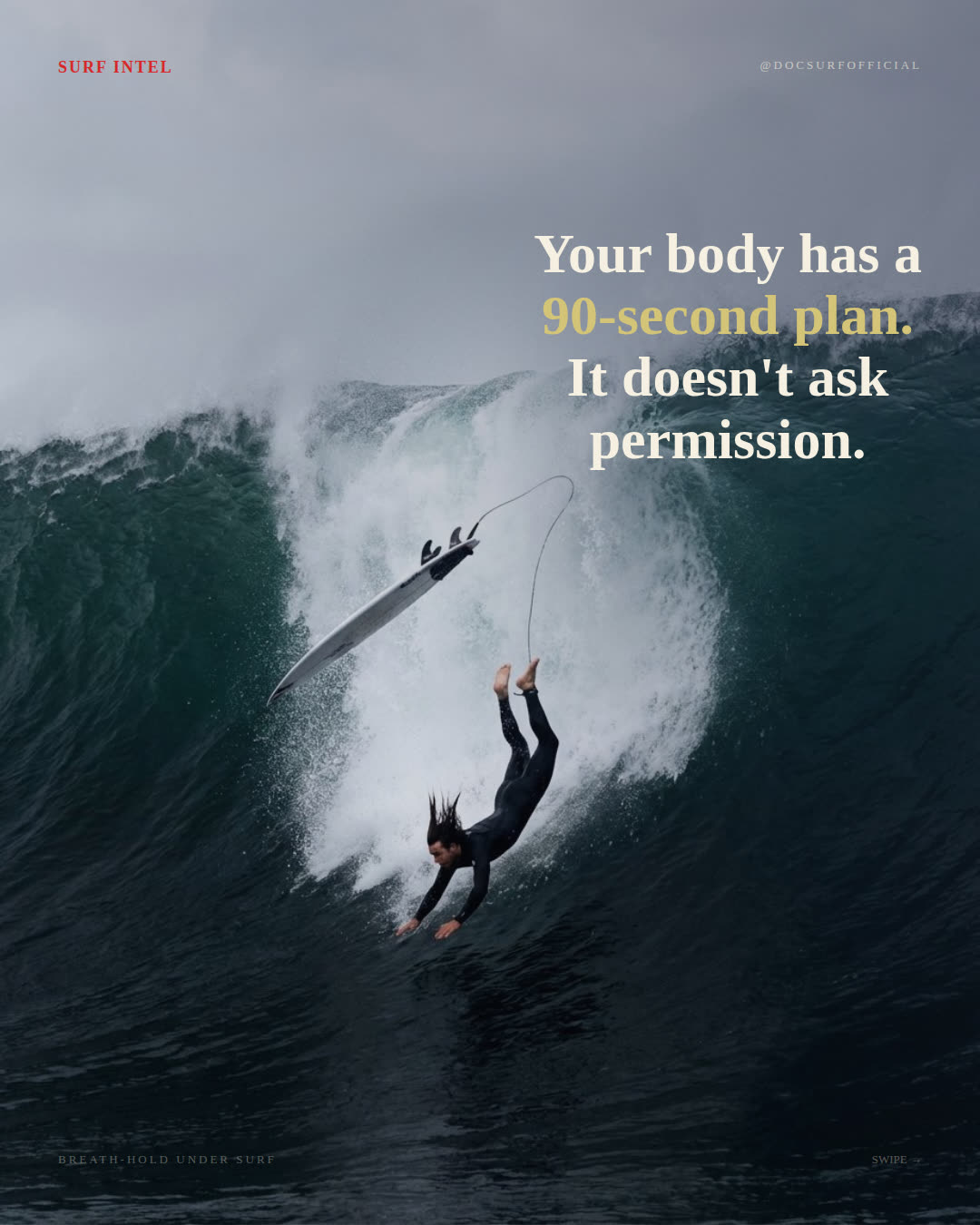
Your body has a 90-second plan. It does not ask permission.
A two-wave hold-down at an outer reef runs roughly 30–60 seconds submerged, a surface breath, then dragged back under. Most surfers describe the experience as getting worked. Physiologically, the sequence is more precise than that, and understanding the sequence changes how it feels when it happens. The body is not improvising. It is running an evolutionarily conserved program in a defined order, with defined triggers, on a defined clock. The surfer who knows the program is not calmer because the situation is less frightening. The surfer is calmer because the signals coming from inside the body have become interpretable.
What follows is a description of that program in three phases, the psychology of the alarm that fires in the middle of it, the paradox of why effort under water accelerates the very thing the effort is trying to prevent, and the narrow window on ascent where consciousness can fail without warning.
Phase One: The Dive Reflex
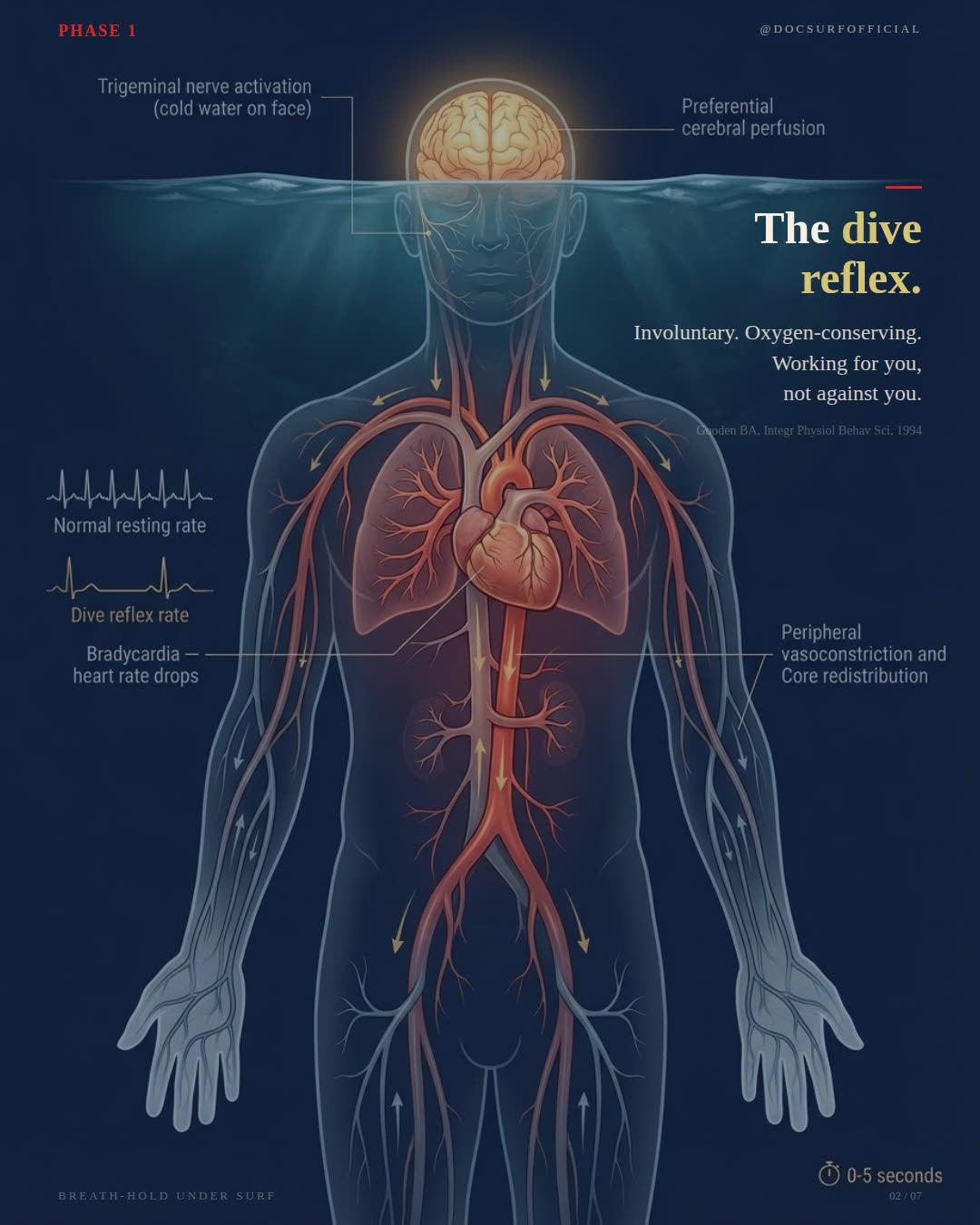
The moment cold water contacts the face, the trigeminal nerve fires and the mammalian dive reflex initiates. Heart rate drops. Peripheral vasculature constricts. Blood redistributes from the limbs toward the core and the vital organs, particularly the heart and the brain. This response is involuntary, it begins within seconds of facial immersion, and it does not require conscious activation (Gooden, 1994).
The reflex is oxygen-conserving by design. Bradycardia reduces myocardial oxygen demand. Peripheral vasoconstriction protects central oxygen stores by limiting circulation to tissues that can tolerate transient hypoxia. The net effect is to extend the window of usable consciousness under water beyond what the same volume of inhaled air would permit at the surface (Paulev et al., 1990).
The dive reflex is working for the surfer, not against the surfer. It is the first thing the body does after the wipeout, and it is the reason a hold-down is survivable at all. Cold water on the face is not the enemy in this sequence. It is the trigger that turns on the protection.
Phase Two: CO2 Accumulation and the Urge to Breathe
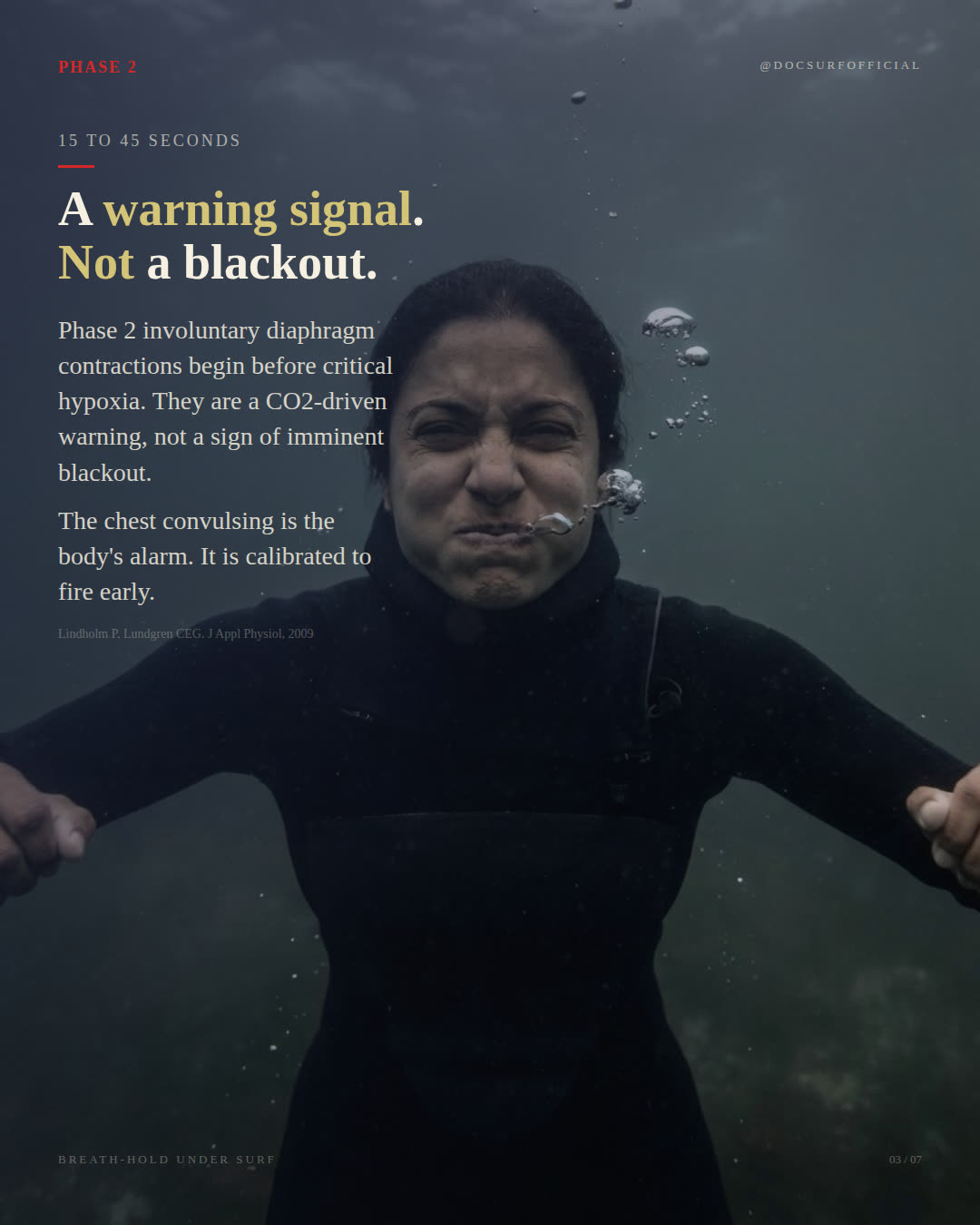
The urge to breathe is not driven by low oxygen. It is driven by rising carbon dioxide.
Peripheral chemoreceptors in the carotid body, and central chemoreceptors in the medulla, detect increasing arterial partial pressure of CO2. As PaCO2 rises during breath-hold, the medulla signals the diaphragm. The diaphragm begins to contract involuntarily. These contractions are sometimes described by surfers as the chest convulsing, the throat locking, or the body trying to inhale against a closed glottis. The sensation is unmistakable, and it arrives before critical hypoxia (Lindholm and Lundgren, 2009).
This is the part of the physiology that is most frequently misunderstood. The diaphragmatic contractions are a CO2-driven warning signal. They are not a sign of imminent blackout. The body is not saying oxygen is gone. The body is saying carbon dioxide has risen past a threshold, and the medulla is now demanding ventilation. The threshold is set conservatively, well above the level at which consciousness is actually at risk in a healthy surfer (Dejours, 1965; Schagatay, 2009).
The chest convulsing is the alarm system. It is not the fire.
Phase Three: The Hypoxic Threshold
Oxygen does eventually fall. Once cerebral oxygen tension drops below the threshold required to sustain consciousness, the surfer blacks out. The interval between the CO2 alarm and the hypoxic threshold is wider than the panic suggests, but it is not unlimited, and it is the phase in which exertion does the most damage.
Motor coordination degrades before the urge to breathe forces a return to the surface. Decision-making degrades alongside it. The surfer who is still functional enough to feel panicked is not necessarily still functional enough to find the surface efficiently. The reserve that remains at this point is the difference between a hard hold-down and an unrecoverable one (Craig, 1961; Lindholm and Lundgren, 2009).
Shallow water blackout originates in this phase. Loss of consciousness from cerebral hypoxia typically occurs on ascent, when hydrostatic pressure drops, the partial pressure of oxygen in arterial blood falls, and the brain crosses the consciousness threshold in the final seconds before the surface (Craig, 1961). The ascent itself is the most dangerous part of the sequence, which is counterintuitive, because the ascent is also the moment the surfer believes the danger is over.
The Psychology of the CO2 Alarm
The panic a surfer feels during a hold-down is disproportionately caused by CO2 accumulation, not by actual oxygen depletion. The body's alarm system is calibrated to fire early, because the cost of false reassurance is catastrophic and the cost of an early warning is only discomfort. From an evolutionary standpoint, the asymmetry makes sense. A creature that surfaces ten seconds before it had to has lost nothing. A creature that stays down ten seconds too long is dead.
The practical consequence is that the most intense sensations of a hold-down, the chest convulsing, the throat working, the conviction that the body is about to fail, arrive in the middle of the timeline rather than at the end. The surfer who interprets those sensations as proof of imminent blackout is reading the alarm correctly as a signal but incorrectly as a verdict.
Understanding this does not make hold-downs comfortable. It makes them interpretable. The signal still fires. The discomfort is still real. What changes is the meaning the surfer assigns to the signal, and meaning is what governs the behavioral response (Lindholm and Lundgren, 2009).
Why Fighting Accelerates the Danger
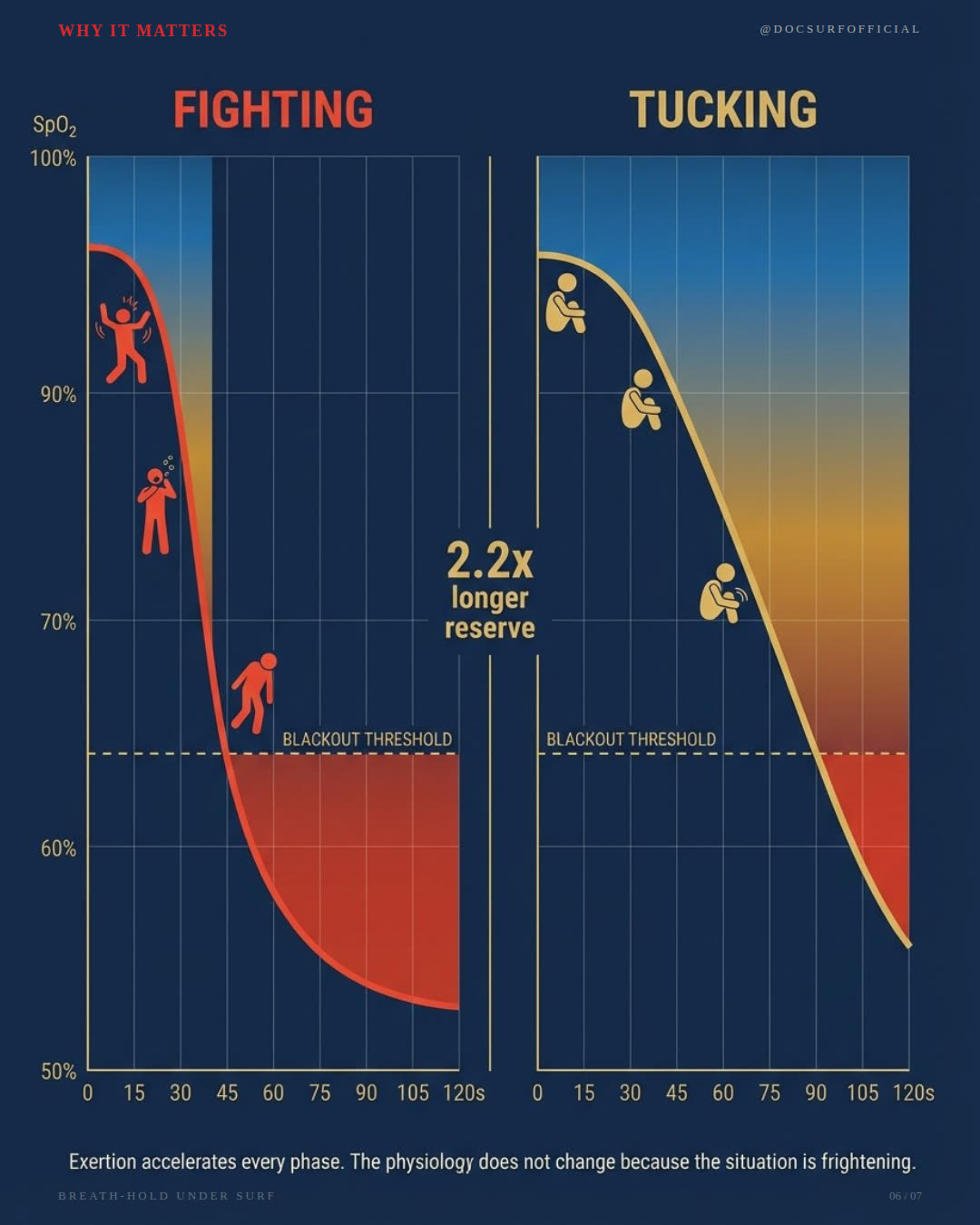
Exertion under water multiplies oxygen consumption. Every contraction of working skeletal muscle burns oxygen the brain could have used. The surfer who fights the hold-down, who thrashes toward the surface against the turbulence, who tries to swim out from under the next wave, burns through the reserve that the dive reflex worked to preserve.
Stillness conserves oxygen. The dive reflex has already begun the work of redistributing blood to the brain and the heart. Adding muscular effort runs in the opposite direction. The body that goes still rides the reflex. The body that fights overrides it (Schagatay and Andersson, 1998; Lindholm and Lundgren, 2009).
There is a second function to stillness, which is protection of the head. A hold-down in a reef break is not just an oxygen problem. It is a mechanical problem. The board is on a leash. The reef is below. Other surfers are in the lineup. The surfer who shields the head, arms wrapped, elbows in, reduces the probability of secondary injury from board strikes or reef contact. Concussion under water compounds hypoxia in ways that make a survivable hold-down unsurvivable.
The surfer who goes still and shields the head reaches the surface in better shape than the surfer who fights. The physiology and the mechanics point in the same direction.
What This Means for Training and Preparation
The physiology does not change because the situation is frightening. The protocol calls for working with the body's program rather than against it, and that work begins long before the wipeout.
Current evidence supports a few observations for surfers who session in conditions where hold-downs are part of the risk profile. Familiarity with the CO2 sensation, gained in controlled static apnea practice with a partner present and competent rescue close, reduces the interpretive error during a real hold-down. A surfer who has felt the diaphragmatic contractions in a pool, with no consequence attached, is less likely to misread the same sensation in the ocean as proof of imminent failure (Schagatay, 2009).
Conditioning under water that emphasizes economy of motion, rather than power output, aligns with the stillness principle. Hyperventilation before a breath-hold is a known driver of shallow water blackout, because it lowers PaCO2 without raising oxygen reserves, which delays the alarm without delaying the actual hypoxic threshold (Craig, 1961). The field gets this wrong frequently. Big breaths before a duck dive feel like preparation. The literature indicates they shorten the warning window without lengthening the survivable one.
None of the above is individualized advice. Training decisions for a specific surfer in a specific environment require direct assessment by a qualified provider.
The Shallow Water Blackout Window
The ascent is the part of the sequence where consciousness is least defended. As the surfer rises through the water column, hydrostatic pressure drops. The partial pressure of oxygen in arterial blood, which has been falling throughout the hold-down, falls further as the surrounding pressure decreases. The brain crosses the consciousness threshold in the final meters before the surface, sometimes in the final seconds (Craig, 1961; Rupp and Perrey, 2008).
There is often no warning. The CO2 alarm has already done its work and been overridden, or the surfer has hyperventilated and the alarm never fired loudly enough to begin with. The lights go out without preamble. The surfer surfaces unconscious, or fails to surface at all, and the people on the lineup may not register the event until seconds later.
This is the rationale for never breath-hold training alone. It is also the rationale for surface partners and direct visual contact during deep training sessions. The window is too narrow and too silent to be managed by the surfer who is in it.
Two observations close this. The panic a surfer feels in a hold-down is disproportionately a CO2 signal, calibrated to fire early. The danger a surfer faces in a hold-down is disproportionately concentrated at the ascent, where the body gives no warning. The two facts do not align in time, which is part of what makes the physiology counterintuitive. The signal is loudest where the danger is lowest. The danger is highest where the signal is silent.
The body has a 90-second plan. The surfer's job is to recognize the plan, work with it, and stay still long enough to let the plan finish.
References
- Craig AB Jr. Causes of loss of consciousness during underwater swimming. Journal of Applied Physiology. 1961;16:583–586.
- Dejours P. Respiration. New York: Oxford University Press; 1965.
- Gooden BA. Mechanism of the human diving response. Integrative Physiological and Behavioral Science. 1994;29(1):6–16.
- Lindholm P, Lundgren CEG. The physiology and pathophysiology of human breath-hold diving. Journal of Applied Physiology. 2009;106(1):284–292.
- Paulev PE, Pokorski M, Honda Y, et al. Facial cold receptors and the survival reflex "diving bradycardia" in man. Japanese Journal of Physiology. 1990;40(5):701–712.
- Rupp T, Perrey S. Effect of severe hypoxia on prefrontal cortex and muscle oxygenation responses at rest and during exhaustive exercise. Journal of Applied Physiology. 2008;105(4):1373–1379.
- Schagatay E. Predicting performance in competitive apnea diving. Part I: static apnea. Diving and Hyperbaric Medicine. 2009;39(2):88–99.
- Schagatay E, Andersson J. Diving response and apneic time in humans. Acta Physiologica Scandinavica. 1998;162(2):157–164.