Head Injury in the Surf: Reading the Breath
The severe end of the spectrum. Why agonal gasping looks like breathing and isn't. The two patterns side by side. Jaw thrust over head-tilt-chin-lift, every time.
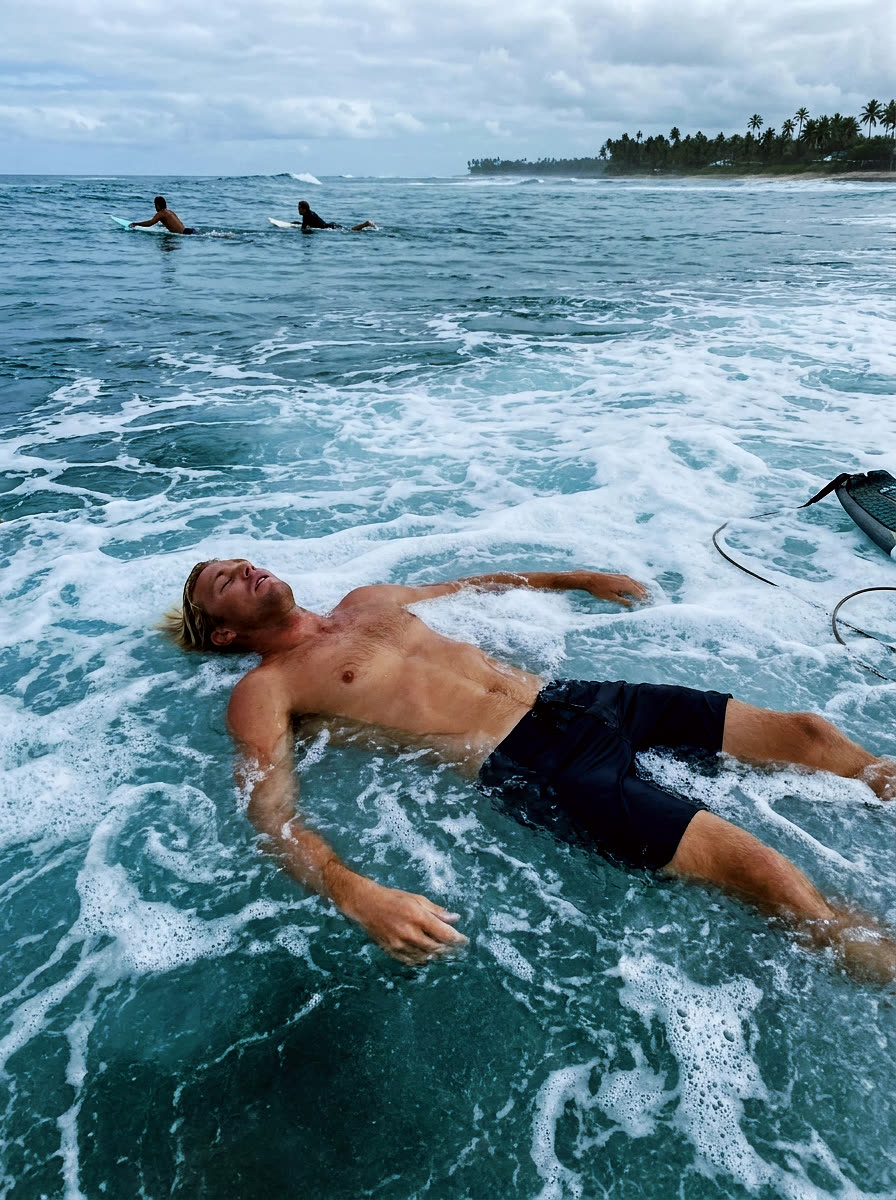
A surfer wipes out on a reef break. He goes down, and he does not come back up on his own. The crew on a nearby boat reaches him within a minute or two, pulls him aboard, and lays him on the deck. His chest moves. There is a sound, irregular and slow, that the crew reads as breathing. The boat begins running for shore. Several seconds pass between each sound. The chest movement is not coordinated with anything that looks like a normal breath. The patient eventually recovers consciousness during transport, which is fortunate, because what the crew was watching on the deck was not breathing.
This is the severe end of the head injury spectrum in surf. The companion Surf Intel post addresses the mild-to-moderate end, where the patient is conscious, oriented, and the framework is SCAT6 / CRT6 assessment. The article below covers what happens when the patient is unconscious on the deck of a rescue boat, when the airway is the only thing that matters for the next 90 seconds, and when the breath pattern the rescuer is watching is not what it appears to be.
Two Insults Converging
A reef wipeout that produces an unconscious patient is rarely one injury. It is two, and the two compound each other.
The first insult is mechanical. Reef contact at speed transmits force through the skull, the cervical spine, or both. Even a glancing impact can produce a traumatic brain injury severe enough to interrupt consciousness, and the position of the head and neck on impact determines whether a c-spine injury accompanies the head injury (ATLS, 11th ed). The reef does not need to be sharp to produce TBI. It needs to be solid and oriented in the wrong direction at the wrong moment.
The second insult is hypoxic. A surfer who is unconscious under water is not protecting his own airway. Submersion physiology runs its full sequence: laryngospasm initially, then relaxation, then aspiration of water into the lungs if the spasm releases before rescue, then progressive hypoxemia and eventually cardiac arrest if the submersion continues (Auerbach's, 7th ed). The window between submersion and irreversible neurologic injury is measured in minutes, and the clock starts the moment the head goes under.
The clinical picture on the deck of a rescue boat is the overlap of the two. The patient may be unconscious from the head injury, from the hypoxia, or from both. The breath pattern, the level of consciousness, and the pulse all have to be interpreted against the possibility that both insults are present simultaneously. This is the reason the field protocol for an unconscious surf rescue patient defaults to assuming TBI plus submersion until proven otherwise.
Why Concussion Teaching Doesn't End at "Shake It Off"
Most of the concussion content surfers encounter is calibrated to the mild end of the spectrum. The patient is on his feet. He is oriented enough to answer questions. The framework is sideline assessment, symptom tracking, return-to-activity criteria. The Surf Intel concussion post addresses that population. SCAT6 and CRT6 are screening and triage tools for the conscious patient, and they are appropriate for the population they were designed for (Echemendia et al., 2023).
The unconscious patient is a different category of problem. The screening tools do not apply. The conversation is no longer about symptom severity, cognitive function, or graded return to surfing. The conversation is about whether the patient is moving air, whether the patient has a pulse, and whether the cervical spine is being protected during whatever the rescuer does next.
The transition from one end of the spectrum to the other is fast in surf. A patient can be conscious and oriented thirty seconds before a hold-down, and unconscious and aspirating sixty seconds after. The field response cannot afford to be calibrated only for the mild presentation. The rescuer who has only learned how to manage a conscious concussion is not prepared for the deck of a rescue boat.
The Two Breath Patterns
The single observation that determines the next ninety seconds is whether the patient is breathing. Two different patterns can both look like breathing to a rescuer who is not specifically watching for the difference.
Agonal respirations are isolated, irregular, and slow. They appear as gasps rather than breaths. The frequency is well below normal, typically fewer than 10–12 per minute and often slower, with uneven spacing between gasps. The pattern frequently includes jaw protrusion, tongue movement, or a brief opening of the mouth without coordinated chest expansion. The sound is sometimes described as a gurgle, a snore, or a sigh. The chest may rise visibly, but the rise is not coupled to a functional exchange of air. Agonal gasping is a brainstem reflex that occurs during cardiac arrest or severe brain injury. It is a sign that the patient is in arrest, not a sign that the patient is breathing (Kleinman et al., 2025; Zhang et al., 2018).
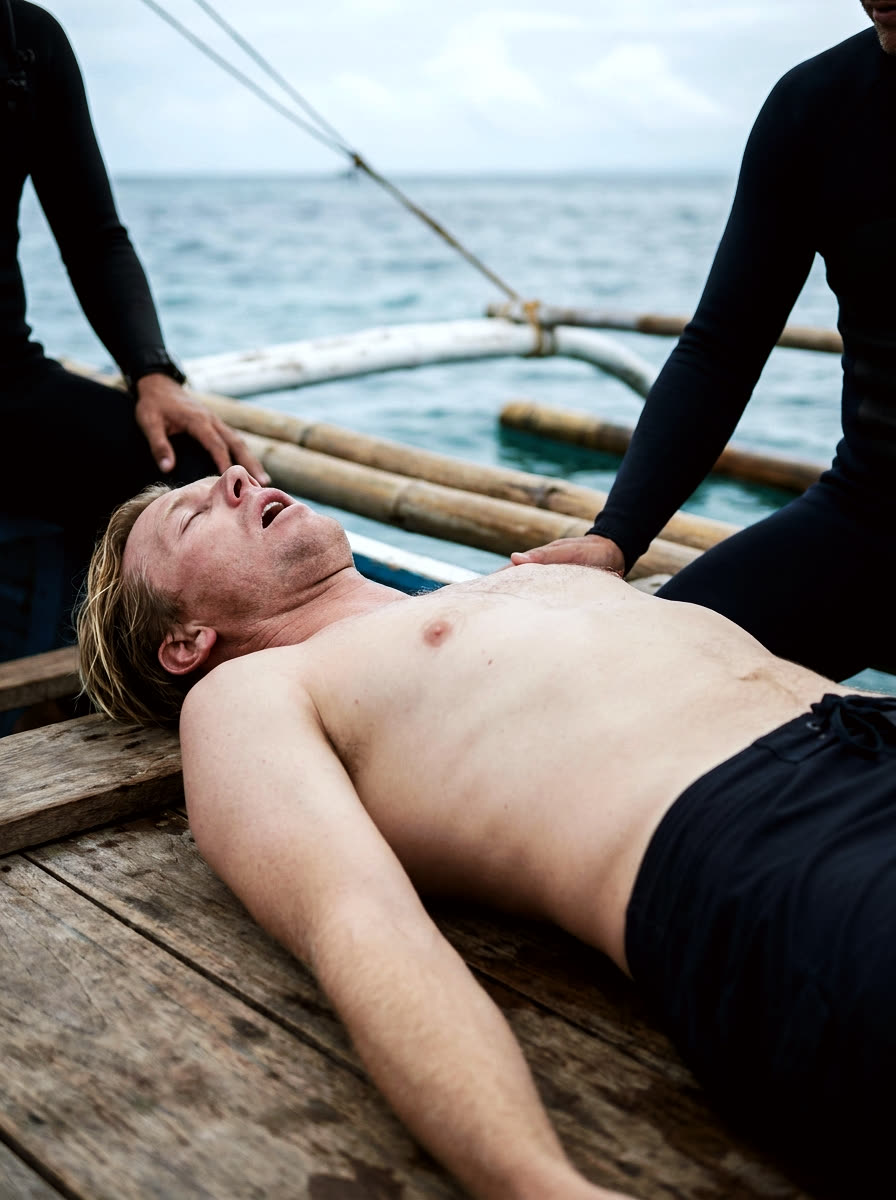

Recovering spontaneous respiration is regular, smooth, and coordinated. The chest rises fully and falls fully. The frequency normalizes toward roughly 12–20 breaths per minute over the first several minutes after consciousness begins to return. The pattern is paired with other returning signs: eye opening, purposeful motor response, recognizable vocalization. The breath is part of a recovering system, not an isolated reflex (Auerbach's, 7th ed).
The discriminators that matter on the deck of a boat, in order of usefulness:
- Frequency. Agonal gasping is slow and uneven. Recovering respiration trends toward normal rate.
- Regularity. Agonal pattern is irregular and isolated. Recovering pattern is rhythmic.
- Coupling. Agonal gasps are not coupled to other signs of recovery. Recovering breaths arrive alongside eye opening, motor response, or returning tone.
- Functional chest rise. Agonal jaw and tongue movement can look like an attempt to breathe without producing meaningful chest expansion. Recovering respiration produces a full, coordinated rise.
The Two Misreads
The field gets this wrong in two opposite directions, and both directions kill the same patient.
The first misread treats the gasps as breathing. The rescuer sees a chest move and hears a sound, concludes the patient is exchanging air, and does not start compressions. Transport begins. Compressions do not.
The second misread treats the gasps as a death rattle. The rescuer recognizes the pattern as agonal, concludes the patient is already past saving, and does not start compressions. The rescuer's read of the pattern is closer to correct than the first rescuer's. The decision that follows is the same.
Both reads delay or withhold the one intervention that determines survival. The patient does not die of the agonal gasping. The patient dies of the misread.
The Correct Read
Agonal gasping in an unresponsive surfer pulled from a wipeout means two things at once. The patient is in cardiac arrest right now. The patient is also in the early, salvageable window of that arrest.
The field decision does not turn on whether the rescuer can identify the gasping pattern by name. The field decision is the AHA 2025 recognition trigger: unresponsive plus no normal breathing equals start compressions. The gasping is not an input to that decision (Kleinman et al., 2025).
The Physiology
Agonal gasping originates in the brainstem. When cerebral perfusion drops below the threshold required to sustain higher cortical function, the primitive respiratory centers in the medulla and pons continue to fire for a window of time. The output of those centers is the gasp pattern: irregular, slow, isolated, often accompanied by reflex jaw and tongue movement. The pattern is the brainstem's signature, not the patient's effort (Zhang et al., 2018).
The reason gasping correlates with better survival when CPR is started is both mechanical and temporal. It is a mechanism and a marker, and both contribute.
As a mechanism, each gasp generates a swing in intrathoracic pressure. The negative-pressure phase assists venous return to the heart. Coronary and cerebral perfusion pressures rise. Intracranial pressure drops modestly. The combination of intermittent gasping and bystander CPR produces better hemodynamics than CPR alone in a patient who is not gasping (Zhang et al., 2018; Bobrow et al., 2008).
As a marker, gasping is most often observed in the earliest minutes of arrest, when shockable rhythms are still likely and the brain has not yet sustained irreversible injury. The presence of gasping selects for a population with a structurally better prognosis. The rescuer who recognizes the pattern and acts on it is intervening on the patient most likely to survive (Zhang et al., 2018; Bobrow et al., 2008).
The submersion sequence runs in parallel. After the airway goes under, the initial response is voluntary breath-holding. As CO2 rises and hypoxia develops, laryngospasm typically occurs, sealing the airway against water entry. Laryngospasm relaxes as hypoxia deepens, and aspiration of water into the lungs becomes possible at that point. Cardiac arrhythmia and arrest follow if the submersion continues. The whole sequence, from initial submersion to arrest, is compressed in patients with concurrent head injury because the protective breath-hold may be absent from the start (Auerbach's, 7th ed).
The clinical picture on the deck combines the two. Agonal gasping in a patient pulled from the water after a reef impact is consistent with cardiac arrest secondary to TBI, submersion, or both. The field response is the same in all three cases.
The Airway
The airway maneuver for any patient with plausible head or neck injury is the jaw thrust, not the head-tilt-chin-lift. In surf, head and neck injury is plausible by default whenever the rescue follows a wipeout, a board strike, or any submersion of unknown mechanism. The cervical spine is presumed unstable until clinical assessment proves otherwise (ATLS, 11th ed; PHTLS, 10th ed).
The technique, in plain language: the rescuer kneels behind the patient's head, with the patient's head positioned between the rescuer's knees, holding the cervical spine inline. The hands run parallel along the sides of the patient's face from above and behind, not crossing. Each hand stays on its own side of the head, palms near the temples and hair, fingers curled behind the bony angle of the mandible, thumbs resting on the chin and pushing forward. The mouth opens as a direct result of the forward thumb motion. The head does not tilt. The neck does not extend. The mandible moves anteriorly at the jaw joint, the tongue lifts off the posterior pharynx, and the airway opens without manipulating the cervical spine.
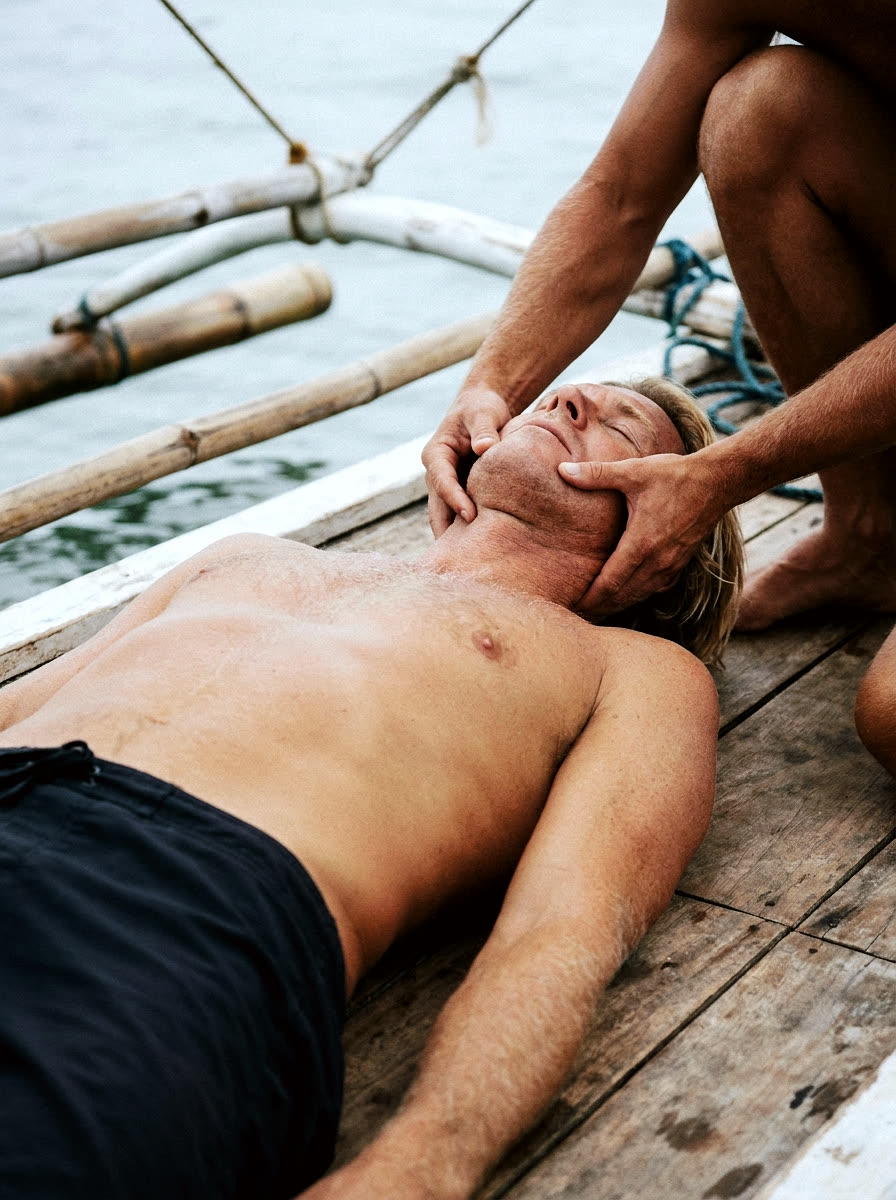
The head-tilt-chin-lift, which is the standard airway maneuver in non-trauma resuscitation, extends the neck. Extension of an unstable cervical spine can convert a stable injury into a cord injury. In a trauma context, including the default surf rescue context, the jaw thrust is the correct maneuver even though it is harder to perform and less familiar to most laypeople (ATLS, 11th ed). The AHA 2025 guidelines refine this with a practical fallback. Use jaw thrust first. If the jaw thrust is ineffective and the airway will not open, head-tilt-chin-lift is permitted because an unopened airway is a worse outcome than minimal neck movement (Kleinman et al., 2025). The fallback is not a default. It is a rescue from a worse failure.
If the rescuer is alone and cannot maintain manual c-spine stabilization and a jaw thrust simultaneously, the airway takes priority. A patient with a protected spine and no airway is not salvageable. The field protocol is to open the airway with the least cervical motion possible and to recruit a second rescuer to hold inline stabilization as soon as one is available (PHTLS, 10th ed).
The Field Response
The first 90 seconds, in sequence:
- Position. Move the patient to a flat, firm surface. The deck of a boat is acceptable. A flexible inflatable surface is not. If the patient is still in the water and a flat surface is not immediately available, the priority is to get him onto one.
- Open the airway. Jaw thrust, neutral neck position, c-spine held inline if a second rescuer is available.
- Assess breathing by watching the chest. Look for full, coordinated rise and fall. Do not count gasping sounds as breaths. Agonal gasps are not ventilation (Kleinman et al., 2025).
- If no normal breathing and no detectable pulse, begin CPR. Per the AHA 2025 guidelines, if an adult is unresponsive with absent or abnormal breathing (including gasping), the lay rescuer should assume cardiac arrest and start compressions. Lay rescuers are not instructed to check for a pulse. Healthcare providers may check for a pulse but for no more than 10 seconds (Kleinman et al., 2025).
- Call for evacuation in parallel. The compressions do not pause while a second person works the radio or the phone.
- Maintain cervical spine immobilization throughout, to the extent possible. A neutral neck position is the goal. If compressions and immobilization conflict, the compressions continue.
A few observations that follow from the protocol. The decision to start CPR is made on two findings: unresponsive and not breathing normally. Pulse assessment by an untrained or under-trained rescuer is unreliable and delays the intervention that matters most. The current evidence supports compressions over pulse checks for lay responders in any arrest scenario, including the surf rescue context (Kleinman et al., 2025).
The second observation is that the worst error in this sequence is misreading agonal gasping as breathing and withholding CPR on that basis. The patient who is gasping is in arrest. The window in which CPR converts that arrest into a survivable event is narrow, and it closes whether the rescuer recognizes the pattern or not.
The third observation is that the response is the same whether the underlying problem is TBI, submersion, or both. The rescuer does not need to diagnose the mechanism on the deck. The rescuer needs to open the airway, recognize the breath pattern, and not delay compressions on a patient who is not breathing.
References
- Kleinman ME, Buick JE, Huber N, et al. Part 7: Adult Basic Life Support: 2025 American Heart Association Guidelines for Cardiopulmonary Resuscitation and Emergency Cardiovascular Care. Circulation. 2025;152(suppl 2):S448–S478. doi:10.1161/CIR.0000000000001369
- Zhang Q, Liu B, Qi Z, Li C. Prognostic value of gasping for short and long outcomes during out-of-hospital cardiac arrest: an updated systematic review and meta-analysis. Scand J Trauma Resusc Emerg Med. 2018;26(1):106. doi:10.1186/s13049-018-0575-1
- Davis CA, Schmidt AC, Sempsrott JR, et al. Wilderness Medical Society Clinical Practice Guidelines for the Treatment and Prevention of Drowning: 2024 Update. Wilderness Environ Med. 2024;35(1):94–111. doi:10.1177/10806032241227460
- American College of Surgeons Committee on Trauma. Advanced Trauma Life Support (ATLS) Student Course Manual. 11th ed. Chicago: American College of Surgeons; 2025.
- National Association of Emergency Medical Technicians. PHTLS: Prehospital Trauma Life Support. 10th ed. Burlington, MA: Jones & Bartlett Learning; 2023.
- Auerbach PS, Cushing TA, Harris NS, eds. Auerbach's Wilderness Medicine. 7th ed. Philadelphia: Elsevier; 2017. Submersion Injuries chapter.
- Echemendia RJ, Brett BL, Broglio S, et al. Introducing the Sport Concussion Assessment Tool 6 (SCAT6). Br J Sports Med. 2023;57(11):619–621. doi:10.1136/bjsports-2023-106849
Supporting reference (seminal evidence on agonal gasping prognosis, superseded by Zhang et al. 2018 meta-analysis above):
- Bobrow BJ, Zuercher M, Ewy GA, et al. Gasping during cardiac arrest in humans is frequent and associated with improved survival. Circulation. 2008;118(24):2550–2554.